
Hospitality Never Sleeps: Expectation vs. Exception

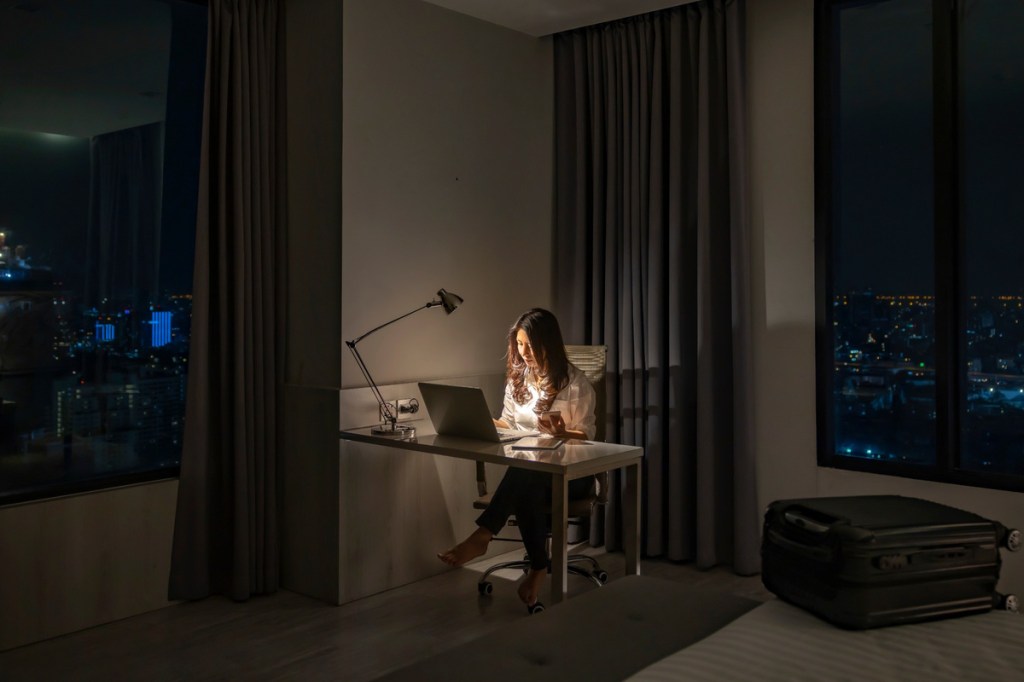
Photo Credit: Adobe Stock / Shine
Skift Take
Hospitality may be a 24/7 business, but its people shouldn’t have to be. Rethinking the industry’s always-on culture could be key to building stronger, more sustainable leadership.
Rethinking the always-on culture in hospitality and its impact on leadership, performance and sustainability
Part of the ongoing series “Leading Hospitality: Inside the Experience”
In hospitality and travel, the concept of a working day has quietly disappeared. There is no clear start, no defined end and, increasingly, no real pause. As the industry has become more global, more connected and more immediate, the expectation of availability has expanded with it. What was once a reflection of dedication has now become an embedded norm: to be reachable at all times, across all time zones, for all needs.
This reality is not limited to one function. It extends across hotels, travel agencies, event teams, commercial departments and leadership roles. A client in New York, an owner in the Middle East and a partner in Europe are all operating on different clocks, yet expecting the same responsiveness. Technology has enabled this level of connectivity, but it has also removed the natural boundaries that once existed within the working day. The industry does not sleep, and increasingly, neither do the people behind it.
For many professionals, particularly in commercial and client-facing roles, responsiveness has become synonymous with performance. A quick reply signals commitment. A late-night response demonstrates ownership. A weekend follow-up shows reliability. Over time, these signals accumulate and shape perception. Availability becomes not just expected, but quietly measured. In that shift, the definition of what it means to perform well begins to change.
At a leadership level, this dynamic becomes even more complex. Senior roles in hospitality require oversight across markets, teams and revenue streams. Decisions often need to be made in real time, with incomplete information and under constant pressure. The expectation to remain continuously connected is rarely stated explicitly, yet it is deeply understood. Being on is part of the role. Boundaries, when they exist, are often self-imposed rather than structurally supported.
The question is not whether this level of engagement is sometimes necessary. In a service-driven, global industry, responsiveness will always be part of the equation. The question is whether constant availability has become the default rather than the exception.
When everything is urgent, nothing is prioritized. When every message requires an immediate response, space for reflection disappears. Strategic thinking, by its nature, requires distance. It requires time to assess, to connect information and to anticipate rather than react. An always-on culture risks shifting leadership from proactive to reactive, from deliberate to immediate.
There is also a longer-term implication for the industry itself. Hospitality relies on people: their judgment, their emotional intelligence and their ability to create meaningful experiences. When the pace of work becomes continuous, the risk is not only exhaustion but also an erosion of quality. Decision-making becomes narrower. Creativity diminishes. Retention becomes more difficult, particularly for those who seek sustainability alongside ambition.
For women in hospitality, this dynamic can carry an additional layer. The expectation to remain constantly available can intersect with other responsibilities, creating an ongoing negotiation between presence and performance. The pressure is not only to deliver but also to demonstrate commitment in visible ways. And visibility, in an always-on culture, is often measured through responsiveness rather than impact.
None of this suggests that hospitality should slow down. The industry is, and will always be, dynamic, responsive and global. But there is a difference between being a 24/7 industry and expecting 24/7 availability from its people. The two are not the same, and treating them as interchangeable creates a model that is difficult to sustain.
As the industry continues to evolve, this becomes a leadership question: not only how we deliver service, but how we structure the environments in which that service is created; not only how quickly we respond, but how effectively we think; not only how present we are, but how sustainably we operate.
The future of hospitality will not be defined solely by excellence in service, but by the systems that support the people delivering it. In a world that never stops moving, the ability to create space, set boundaries and lead with intention may become one of the most valuable capabilities of all.