
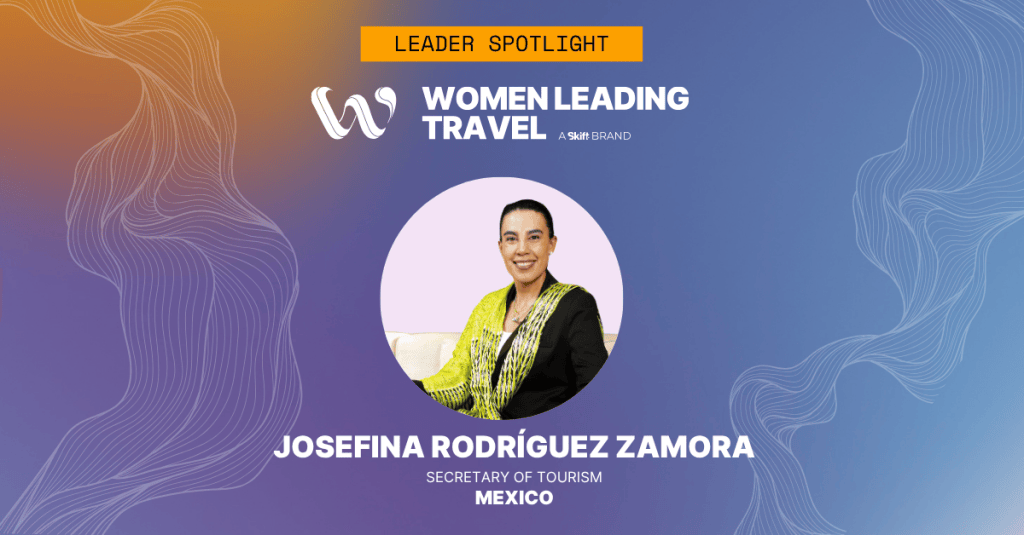
Leader Spotlight: Josefina Rodríguez Zamora, Secretary of Tourism, Mexico

Skift Take
As Mexico’s secretary of tourism, Josefina Rodríguez Zamora is helping shape the country’s tourism future while championing community-driven growth and creating more opportunities for women to lead.
In celebration of Hispanic Heritage Month, we’re excited to highlight Josefina Rodríguez Zamora, Mexico’s secretary of tourism, as this week’s Women Leading Travel Leader Spotlight. She shares the experiences that have shaped her career journey, the impact tourism can have on communities and why creating opportunities for the next generation of women remains central to her work.
1. Your career has taken you from leading tourism in Tlaxcala to serving as Mexico’s secretary of tourism. What has been the most defining moment in your leadership journey so far?
Without a doubt, one of the moments that most shaped my career was working to showcase everything Tlaxcala has to offer to the world. It reinforced something I deeply believe: There are no small destinations when there is identity, community and a compelling story to tell. It was there that I also learned that tourism is built on the ground, by listening to people and working together.
Then came the tremendous responsibility of leading Mexico’s Ministry of Tourism. Moving from promoting the greatness of one state to having the opportunity to explore, understand and showcase the greatness of an entire country has been both a privilege and a challenge. Today, I have the opportunity to represent a new generation of women in public service and demonstrate that we can lead with accessibility, energy and results.
2. What do you love most about working in travel and tourism, and what continues to excite you about the industry?
Tourism has something unique: It creates positive stories. Behind every growing destination are families finding opportunities, artisans showcasing their craft, young people securing employment, traditional cooks preserving our roots and communities turning their heritage into a source of well-being.
That is what excites me most. Mexico is vast and diverse; there is always a new story, flavor, community or landscape to discover. My work allows me to experience them and, more importantly, help others discover them as well. The challenge is ensuring that every visitor contributes to local prosperity and that tourism positively transforms the lives of those who live in our destinations.
This impact is reflected in the latest results we are seeing across the country. In the second quarter of 2026, tourism employment in Mexico reached its highest level on record, with more than 5.067 million people employed in the sector, representing 9.3% of all national employment. What is especially meaningful is that 54% of those jobs are held by women, underscoring tourism’s role in expanding opportunities, strengthening local economies and creating pathways for growth in communities throughout Mexico.
3. What is one lesson you learned early in your career that still influences how you lead today?
That tourism cannot be built from behind a desk. You can have great plans, but if you do not listen to the people who live in the destination, welcome visitors each day, cook, guide, create, innovate and preserve traditions, it is difficult to build policies that truly work.
That is why I like to be in the field, traveling, listening and engaging in conversation. Many of the best ideas come directly from communities. Governing is also about listening and understanding that the strongest public policies are not built for people, but with them. This principle remains at the core of my leadership philosophy.
4. Who has had the greatest influence on your leadership style, personally or professionally, and what did you learn from them?
I have been fortunate to learn from many great leaders, but today we are living through a particularly important moment with President Claudia Sheinbaum. Seeing Mexico’s first female president lead the country’s transformation with preparation, determination, sensitivity and closeness to the people is an inspiration for many of us.
What inspires me most about her leadership is the combination of technical expertise and human connection. She also represents something much larger: Girls and young women across Mexico are growing up knowing that a woman can reach the highest decision-making position in the country. As she has said, this is the time for women, and those of us with public responsibilities must also help pave the way for those who follow.
5. You hold a highly visible role with significant demands on your time. How do you approach work-life balance and make space for yourself outside of work?
I do not believe there is a perfect formula for achieving balance. There are very demanding days filled with travel, meetings and schedules that begin early and end late. For me, it is important to stay connected to my family, my roots and the people who remind me who I am beyond my title.
I have also learned to value the small moments. A meal with family, a meaningful conversation or simply taking time to disconnect can make a tremendous difference. Public service requires a great deal, but to give your best, you also need those personal moments that keep you grounded.
6. When your schedule becomes particularly demanding, what habits or routines help you stay grounded and focused?
I have an outstanding team, and that makes all the difference. I learned that leadership is not about trying to do everything yourself; it is about building strong teams, trusting people, delegating effectively and being clear about priorities.
When the schedule becomes particularly intense, I try to remember why we do this work. Behind every meeting, tour or strategy are real people and communities. Returning to that purpose helps keep everything in perspective: We want more people to discover Mexico and for tourism to create prosperity. When you are clear about the “why,” it becomes much easier to organize everything else.
7. What is one leadership challenge you’ve faced that ultimately made you a stronger or more effective leader?
Mexico has 32 states and an extraordinary diversity of tourism offerings. You cannot assume that one strategy will work equally well everywhere. The needs of a beach destination are different from those of a rural community, a historic city or a Magical Town.
This has taught me the importance of listening and understanding that coordination also means recognizing differences. Our role is to build a national vision in which everyone has a place and every region can showcase what makes it unique. Rather than imposing solutions, we seek to develop them together with states, municipalities, communities and the private sector.
8. As a woman who has advanced to one of the highest levels of leadership in tourism, what advice would you give to women who aspire to have greater influence in the industry?
Prepare yourself, believe in your abilities and do not be afraid to raise your hand. For a long time, there were spaces that seemed reserved for men. Today, we are proving that women can not only be part of those spaces but lead them.
I also strongly believe in supporting one another. Reaching a leadership position is important, but creating opportunities for other women is even more important. We need to build networks, recommend one another, support one another and recognize the talent of other women. Female leadership already exists at every level, from major corporations to local communities and Indigenous villages.
9. When you travel for yourself rather than for work, what does your ideal trip look like, and is there a destination in Mexico you return to again and again?
It has been a long time since I took a trip solely for vacation, but as secretary of tourism, I have had the privilege of visiting places that continue to surprise me and deepen my appreciation for Mexico’s richness and diversity. I often say that we are the Ministry of Good News: Every new destination I discover is one I want both Mexico and the world to discover as well.
After the World Cup, we will launch the campaign “They Came for the World Cup, They’ll Return for Mexico” to take advantage of that incredible global spotlight and encourage visitors to come back and explore everything they may not have had the opportunity to experience during their first visit, including our culture, gastronomy, communities and destinations across all 32 states.
10. What’s something people might be surprised to learn about you outside of your professional life?
Perhaps the fact that my family has been involved in the restaurant industry for many years. That has allowed me to understand tourism from a different perspective: that of the people who open their businesses every day, welcome guests, pay attention to every detail and know that a great experience can inspire someone to return.
I believe that experience has also helped me in public service. Behind the major tourism figures and statistics are thousands of small businesses and family-owned enterprises working hard every day. When we talk about tourism, we are talking about people, and that is something we should never lose sight of.