
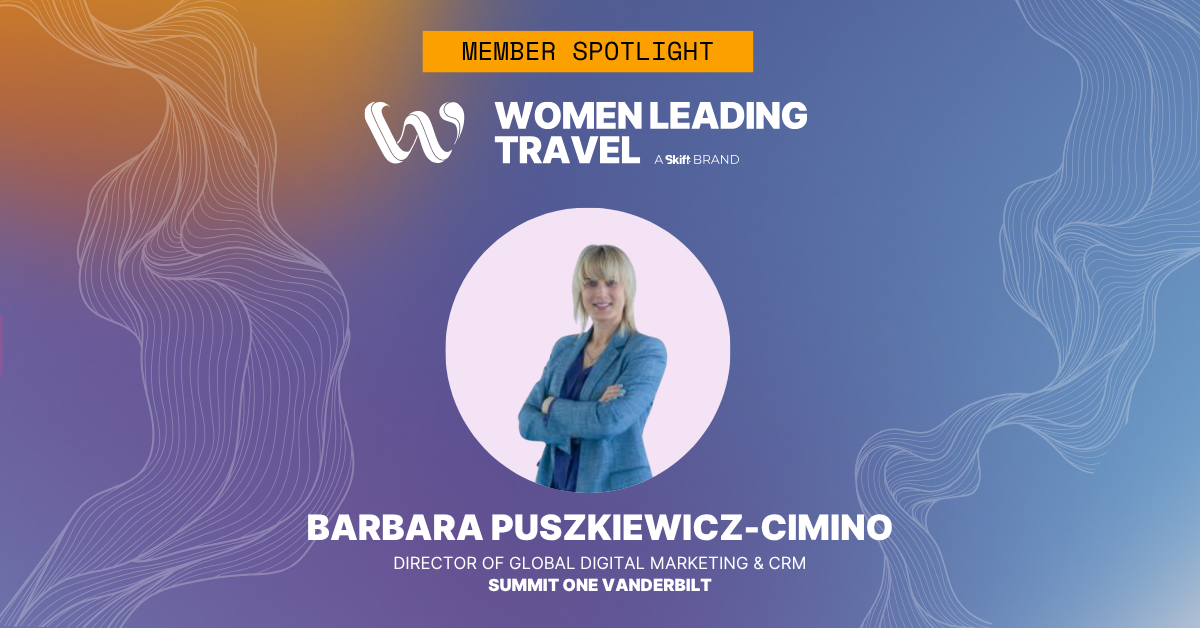
Member Spotlight: Barbara Puszkiewicz-Cimino, Director of Global Digital Marketing & CRM, SUMMIT One Vanderbilt

Skift Take
From self-mastery to AI-powered personalization, this travel leader shares the principles shaping how she builds teams, drives growth and creates experiences that resonate.
Each week, Women Leading Travel invites a member of our community to share a little more about the experiences, perspectives and lessons that have shaped her as a leader. In this edition, we explore everything from leadership and industry trends to career advice, travel and the value of community.
What’s the best book you’ve read recently?
A book I keep coming back to is "Unreasonable Hospitality" by Will Guidara. What stayed with me is the idea that hospitality is not just about service; it is about the emotional memory you create for someone. That is very relevant to travel and attractions. People may buy a ticket, book a trip or visit a destination, but what they really remember is how the experience made them feel.
That idea has influenced how I think about growth, CRM, digital journeys and guest experience. The best marketing cannot compensate for an experience that does not deliver emotionally. But when the experience, the brand, the data, the technology and the team are aligned, marketing becomes much more powerful.
What do you love most about the industry?
I love that travel and hospitality sit at the intersection of emotion, culture, commerce and memory. We are not simply selling products. We are helping people decide where to spend their most valuable time: their vacations, celebrations, anniversaries, family moments and once-in-a-lifetime trips.
There are very few industries where performance marketing, brand storytelling, operational excellence and guest experience are so deeply connected. A campaign may inspire the visit, but the full organization determines whether that guest leaves delighted, returns, recommends us or becomes part of the brand story. That is what makes this industry so challenging and so rewarding.
What is something the community may be surprised to learn about you?
People may be surprised to learn that I played soccer in college and that sports shaped a lot of who I am as a leader. I learned early that talent matters, but discipline, resilience, preparation and trust in your teammates matter more.
I still bring that athlete mindset into work. I care about the score, but I also care deeply about how the team plays together. Are we communicating clearly? Are we making each other better? Are we learning from losses quickly? Are we staying composed under pressure? That team mentality has been one of the biggest influences on my leadership style.
What’s the toughest part of being in charge?
The toughest part is carrying ambiguity while still creating clarity for the team. In leadership, you often have to make decisions before every answer is available. You may be balancing financial pressure, guest expectations, technology constraints, stakeholder opinions, deadlines and team capacity all at once.
I think the real work of leadership is not pretending everything is simple. It is taking complexity, organizing it and helping the team understand what matters most right now. That requires judgment, calm and communication. It also requires the humility to adjust when new information comes in.
What are your nonnegotiables when it comes to work-life balance?
My nonnegotiable is protecting the habits that keep me clear-headed and effective. For me, that means movement, time to reset and space to think. I have learned that when I am constantly reacting, I am not leading at my best.
I also believe work-life balance is not only about hours. It is about sustainability. There will always be intense seasons, especially in travel, with openings, launches and major campaigns. But intensity cannot become the permanent operating model. Strong teams need recovery, focus and realistic priorities if they are going to deliver excellent work over time.
What woman inspires you right now and why?
Angela Ahrendts is someone I find very inspiring. I have always admired how she thought about retail not simply as a transaction, but as an experience. Her work at Apple helped elevate the Apple Store into more than a place to buy products. It became a destination: a space for learning, community, product discovery, creativity and brand connection.
That way of thinking is very relevant to travel and hospitality. The strongest brands are not only selling access, tickets, rooms or products. They are designing moments people want to be part of and remember. I am inspired by leaders who understand that commercial success and emotional connection are not separate. When the experience is strong enough, it becomes part of the brand’s growth engine.
What is one industry trend you’re closely tracking and why?
I am closely tracking the shift from broad digital marketing to intelligent, personalized journey orchestration, especially with AI becoming more embedded in how people plan, evaluate and book travel.
For years, the industry has talked about personalization, but much of it was still rules-based: a segment, an email, a trigger, a retargeting pool. What is changing now is the ability to understand intent across the full journey and respond in more dynamic ways. That includes AI-assisted trip planning, predictive CRM, creative optimization, conversational search, content built for AI discovery and more connected guest data.
The opportunity is exciting, but it also raises the bar. Brands will need stronger first-party data, clearer value propositions, better content and more trust. In a world where AI can compare options instantly, the brands that win will be the ones that are both discoverable and genuinely distinctive.
What is one thing you look for when interviewing a job candidate?
I look for ownership. Skills are important, but ownership is what tells me how someone will operate when things get messy.
I like candidates who can explain not only what they did, but why they did it, what changed because of it, what they learned and what they would do differently now. I am less interested in perfect answers and more interested in people who think clearly, take responsibility, understand the business impact of their work and care about making the team better.
What’s something that you learned about yourself in the past year?
I learned that I am at my best when I am building across functions, not just within one lane. Growth is rarely a marketing-only problem. It usually lives across marketing, CRM, data, technology, product, operations and guest experience.
The past year reinforced for me that I enjoy work where there is complexity, ambiguity and a need to connect dots. I like taking something that feels scattered and helping turn it into a system, a strategy and a path forward.
What is the best piece of advice you’ve ever received?
One of the best pieces of advice I have received is: Do not confuse activity with progress.
That advice has stayed with me because, in fast-moving organizations, it is easy to be busy. There are always meetings, reports, campaigns, decks, platforms and urgent requests. But leadership requires stepping back and asking: What are we actually trying to move? What decision needs to be made? What outcome are we changing? What is noise, and what is signal?
That advice has helped me become more disciplined about prioritization and more focused on business impact.
What values are most important to you as a leader?
Clarity, accountability, curiosity and respect.
Clarity because teams cannot execute well if they do not understand the goal. Accountability because trust depends on people doing what they say they will do. Curiosity because the best ideas often come from asking better questions, not from assuming we already know the answer. And respect because how we work matters. Results are important, but so is the culture we create while achieving them.
What’s the most important thing people should know about you?
People should know that I care deeply about building things that work in the real world. I love strategy, but I am not interested in strategy that only looks good in a deck. I care about whether the idea can be operationalized, measured, adopted by the team and felt by the customer.
I am also someone who brings a lot of heart to the work. I care about results, but I also care about people, teams and the experience we are creating for guests.
What’s a tip you have for productively leading a hybrid team?
Be intentional. Hybrid work does not fail because people are in different places. It fails when communication, ownership and decision-making are unclear.
For hybrid teams, I think leaders need to be very explicit about priorities, timelines, decision rights and what requires live discussion versus what can be handled asynchronously. I also think it is important to create moments for real connection, not just status updates. A hybrid team can be highly productive, but it needs rhythm, clarity and trust.
Where is your favorite place you’ve traveled to? Why?
Paris will always be one of my favorite places. It is a city that understands the power of beauty, architecture, food, art and atmosphere. There is a feeling in Paris that is hard to replicate. You can walk the same street more than once and notice something different each time.
I also love that Paris reminds us why travel matters. It is not only about seeing a place. It is about being changed, even slightly, by the way a place makes you look, listen, taste and feel.
What is the top item on your bucket list?
One of the top items on my bucket list is to continue seeing the world through experiences that combine culture, nature and human connection. I am less interested in checking places off a list and more interested in meaningful travel.
I would love to spend more time exploring places that feel both expansive and grounding, whether that is a beautiful city, a remote landscape or a destination with deep history and local character.
What do you do to recharge?
Movement helps me recharge. Walking, exercising, being outside or doing anything that gets me out of my head and back into my body helps reset my energy.
I also recharge through travel, food, time with people I love and moments of quiet. In a work world that moves very quickly, I have learned to value stillness more. Sometimes the best ideas come when you finally give yourself enough space to think.
What is your biggest accomplishment?
My biggest accomplishment is building a career across very different industries and proving that the fundamentals of growth are transferable when you understand people, data, technology and experience.
I have worked across attractions, entertainment, nonprofit and hospitality-adjacent environments, and in each place, the challenge was different. At The Michael J. Fox Foundation, the work was about using CRM, data and marketing technology to deepen engagement and scale meaningful communication. At Merlin Entertainments, it was about regional growth, attraction marketing and go-to-market execution. At SUMMIT One Vanderbilt, it has been about building performance marketing, CRM, SEO and digital experience, and now supporting global expansion for a premium experiential brand.
What I am proud of is not one campaign or one metric. It is the ability to build modern growth systems that connect brand, performance, CRM, guest experience and business outcomes.
What advice would you give to the next generation of female leaders?
Do not wait until you feel 100 percent ready. Readiness often comes after you step into the room, not before.
I would also tell women to learn the language of the business. Creativity, empathy and communication are powerful, but they become even more powerful when paired with financial fluency, data, operational understanding and strategic judgment. Know your numbers. Understand the business model. Ask smart questions. Build relationships across functions. And do not shrink your ambition to make other people comfortable.
What gets you up in the morning?
I am motivated by the opportunity to build, improve and move things forward. I like work that has momentum. I like solving problems that require both strategic thinking and practical execution.
What gets me up in the morning is knowing that the work can have a real impact: on a business, on a team, on a guest experience and on how people remember a brand. In travel and hospitality, that impact is tangible. You are part of someone’s day, trip, celebration or memory. That matters.
What do you like most about being a member of Women Leading Travel?
What I value most is being part of a community of women who understand both the opportunity and the complexity of this industry. Travel and hospitality require resilience, creativity, commercial discipline and constant adaptation.
Women Leading Travel creates space for honest conversations, shared learning and visibility for women who are shaping the future of the industry. That matters because leadership can be demanding and communities like this remind us that we are not building alone.
Connect with Barbara on LinkedIn to learn more.